GVVMA
Newsletter
Winter 2026
Psychology of the “Guilt Trip” in Veterinary Medicine
You can care deeply about your team and your patients and still say no.
Cover illustration created by NYSVMS staff using AI tools

Genesee Valley Veterinary Medical Association · Quarterly newsletter
Read the FeaturePage 2
Cover Feature
Psychology of the “Guilt Trip” in Veterinary Medicine
Lori D’Alessandro, LCSW
It’s 6:45 PM. You were supposed to leave an hour ago. A colleague catches you at the door: “I really don’t know how we’ll manage without you covering that extra shift.” Your stomach drops. Your chest tightens. Before you’ve had a single conscious thought about your schedule, your body has already made a decision: stay.
That reaction isn’t a character flaw, and it isn’t a sign you don’t care enough about your team. It’s neurology. Understanding what’s happening in your brain in that moment, and how it differs from a grounded, values-based decision, is the first step toward responding instead of reacting the next time someone tries to guilt you into abandoning your own limits.
Guilt Is a Threat Response, Not a Moral Compass
When a colleague implies you’re letting the team down, your brain doesn’t process it as neutral information. It processes it as a social threat. Research using neuroimaging has found that social rejection and exclusion activate the dorsal anterior cingulate cortex (dACC), the same region implicated in the distressing, affective component of physical pain (Eisenberger, Lieberman, & Williams, 2003; Eisenberger & Lieberman, 2004). In other words, the brain doesn’t clearly distinguish “my colleague is disappointed in me” from an actual injury. It reacts to both with overlapping alarm circuitry.
This is where the amygdala comes in. The amygdala is the brain’s rapid threat-detection center, and it responds to the possibility of disapproval, conflict, or abandonment almost as fast as it responds to a physical threat. When a guilt trip lands, that alarm system fires first, often before the prefrontal cortex, the region responsible for reasoned, values-aligned decision-making, has had time to weigh in.
That’s the neurological sleight of hand behind a guilt trip. It hijacks a threat-response system that evolved to protect group belonging and uses it to override a boundary you’d otherwise hold with a clear head. The urgency you feel isn’t information about the actual stakes of saying no. It’s a stress response trying to help you avoid social rejection and exclusion.
What’s Different When You Respond From a Boundary
Responding out of a genuine professional boundary engages a different circuit, one centered in the prefrontal cortex, particularly the regions involved in weighing long-term consequences and staying aligned with personal values. This is the part of the brain that can hold two true things at once: I care about this team and I am not available for this request, without treating the second as a betrayal of the first.
One of the clearest demonstrations of how the prefrontal cortex can regulate the amygdala’s alarm comes from research on affect labeling, the simple act of naming an emotion. In a widely cited fMRI study, Lieberman and colleagues (2007) found that when participants put a feeling into words, activity in the right ventrolateral prefrontal cortex increased while activity in the amygdala decreased, and the two were inversely related. Simply naming what you’re feeling, in this case, “that request just triggered guilt,” even internally, measurably calms the same alarm system a guilt trip exploits.
This regulatory shift takes real neural resources, and the prefrontal cortex is the first system to lose ground under fatigue or acute stress. That’s part of why boundary-setting gets harder the longer the hours worked and the more depleted a clinician already is. A professional who is sleep-deprived and already at capacity is neurologically primed to default to the amygdala’s guilt-driven yes, because the very brain region that supports a grounded no is the one running lowest on resources by hour eight, nine, ten, or more of a shift.
Why This Distinction Matters in Veterinary Medicine Specifically
Veterinary professionals are especially vulnerable to guilt-driven decision-making for a few converging reasons. Veterinary medicine tends to draw people with high empathy and a strong sense of responsibility toward patients and colleagues alike. Vet med culture often reinforces self-sacrifice as a marker of competence. And chronic understaffing means the request to do more, stay later, take another case, is rarely hypothetical. It’s a given.
That combination creates ideal conditions for guilt to masquerade as duty. Over time, a nervous system repeatedly hijacked by guilt rather than guided by values doesn’t just produce a bad day. It contributes to the slow accumulation of exhaustion that characterizes much of the burnout seen across the field.
Standing Your Ground: What You Can Do
Decide in advance, not in the moment. The prefrontal cortex does its best work when it isn’t also managing an active stress response. Deciding ahead of time what your limits are means you’re recalling a decision under pressure rather than making one from scratch while your amygdala is already activated.
Use short, repeatable language. A boundary that requires an in-the-moment paragraph of justification invites your depleted prefrontal cortex to improvise under exactly the conditions it performs worst in. A short, rehearsed script reduces the cognitive load of holding the line. Examples: “I want to help, but I’ve been on my feet since early this morning. I need to stop here.” Or: “I know coverage is tight right now, and that’s a real problem for the schedule to solve. I still can’t be the solution today.” (See below for more script examples.)
Name the guilt trip internally, even if you don’t say it aloud. Based on the affect-labeling research above, simply recognizing “this is guilt talking, not a fact about what’s right” engages the prefrontal regulatory pathway and measurably quiets the amygdala’s alarm (Lieberman et al., 2007). The recognition itself starts to change the physiology of the moment, before you’ve even responded out loud.
The Bottom Line
A guilt trip works by engaging your empathy, one of your most valuable clinical assets, and turning it against your own sustainability. The reaction it produces is fast, physiological, and designed to resolve discomfort as quickly as possible. A boundary-based, prepared response is slower, values-driven, and tolerant of short-term discomfort in service of long-term integrity.
You can care deeply about your team and your patients and still say no. Those two things were never actually in conflict. The guilt trip just causes your brain to feel that way.
Sample Scripts:
They say: “I’ve/We’ve done so much for you.”
Response: “I really do appreciate how much you’ve helped me out, but I’m just not able to commit to this right now.”
They say: “You’re making me feel bad/sad/angry/etc.”
Response: “I understand you feel bad/sad/angry/etc.. but I’ve thought it through and my answer is still no.”
They say: “I can’t believe you aren’t going to do this for me.”
Response: “I know this isn’t the answer you were hoping for, but I’m just not in a position to do it.”
They say: “I covered your shift before/loaned you my car/bought you lunch. Why won’t you do this for me?”
Response: “I really appreciated you covering for me then, but my schedule/capacity is totally different right now so I’m not able to return the favor this time.”
They say: “Seriously? I can’t believe you aren’t going to…”
Response: “I know it’s disappointing, but my answer is still no.”
Books on boundaries for further reading:
- Nedra Glover Tawwab, Set Boundaries, Find Peace – a licensed therapist’s practical, CBT-informed guide.
- Henry Cloud & John Townsend, Boundaries: When to Say Yes, How to Say No to Take Control of Your Life – the field’s classic reference text; comprehensive but written from an explicitly faith-based framework.
- Manuel J. Smith, When I Say No, I Feel Guilty – older (1975) but it’s the origin of the “broken record” technique.
- Nancy Levin, Setting Boundaries Will Set You Free – introduces the “Boundary Pyramid” tool.
- Eamon Blackthorn, Say It Right Every Time. Gives you the exact words to say in every difficult conversation.
References →
Eisenberger, N. I., Lieberman, M. D., & Williams, K. D. (2003). Does rejection hurt? An fMRI study of social exclusion. Science, 302(5643), 290–292.
Eisenberger, N. I., & Lieberman, M. D. (2004). Why rejection hurts: A common neural alarm system for physical and social pain. Trends in Cognitive Sciences, 8(7), 294–300.
Lieberman, M. D., Eisenberger, N. I., Crockett, M. J., Tom, S. M., Pfeifer, J. H., & Way, B. M. (2007). Putting feelings into words: Affect labeling disrupts amygdala activity in response to affective stimuli. Psychological Science, 18(5), 421–428.

Page 3
Practice Management
Financing as a Core Business Strategy: A Moment by Moment Playbook

Let’s take a hands-on prescriptive look at some of the key moments where you can optimize financing as part of your strategy for growth and medical compliance. We know that pet owners are concerned about cost and that they want payment options. Here are some great ways to integrate financing into your practice at key moments throughout the day.
The moment they go to your website
Don’t miss this opportunity. We’ve seen beautiful, comprehensive sites for veterinary clinics and hospitals that have nothing to say about payment options. Or the information is buried within the site. Let people know right away. Right on your home page. With a button or CareCredit logo that links to more information. Pet owners appreciate knowing about payment options before their appointment.
The moment they arrive
Have information about payment options prominently displayed in the waiting area and at the check-in desk. As a CareCredit provider, this means having educational brochures on display and your custom QR code visible as an easy way for clients to apply for and learn more about your financing options.
The moment a client hesitates due to cost
The moment a concern is raised about the costs associated with your detailed recommendations for care, validate their concern. Here’s a sample script: “I can see this is a lot to process. We both want to get your pup the care he needs. Many of our clients use the CareCredit credit card for these larger estimates. It’s a great way to break the cost into easy monthly payments. You can scan our QR code to find out more and apply right now if you’re interested.”*
The moment you follow up on a pending treatment plan
For clients who take a wait and see attitude be sure to follow up with an email. Here are four different approaches. See which one, or which combination of these approaches, works best for your practice.
Focus on monthly payments
A personalized email about the pet’s treatment plan that leads with the actual estimated monthly cost of care. Use the CareCredit calculator in their Provider Center to get this estimate.
Empathetic focus on the pet’s health
Acknowledge that the visit may have been a lot to take in, that the pet’s health is a shared priority and that you offer payment options to help them move forward with care.
Urgent focus on prevention
Where you frame your treatment plan as a way to keep the current situation from escalating into an emergency, using monthly payments as an easy pathway to care.
Focus on simple steps
Emphasize making a quick call to discuss payment options or how easy it is to apply for CareCredit and get an instant decision. Be sure to include your email link to CareCredit.
The moments of truth
You may have a clinic filled with dogs, cats, hamsters and guinea pigs, but there’s also an elephant in the room: cost. Address it head-on with openness and empathy online and in person before, during and after the visit.
*Download the AVMA E-Book “Language That Works” for more on communicating about veterinary care and how to have more successful cost conversations.
Disclosure →
This content is subject to change without notice and offered for informational use only. You are urged to consult with your individual business, financial, legal, tax and/or other advisors with respect to any information presented. Synchrony and any of its affiliates, including CareCredit, (collectively, “Synchrony”) make no representations or warranties regarding this content and accept no liability for any loss or harm arising from the use of the information provided. Your receipt of this material constitutes your acceptance of these terms and conditions.
Page 4
Advertisement

Page 5
Association news
2027 NYSVMS Integrative Medicine Seminar: Endocrine & Hormonal Health January 30-31
Register for the 2027 NYSVMS Integrative Medicine Seminar Endocrine & Hormonal Health January 30-31 which is 2 days of online programs which will earn you 12 NYS CE hours. The first day, Saturday, January 30th will run from 11 AM-7 PM and include topics such as: Diet and nutrition, Chinese medicine approach to Cushing’s and Addison’s disease and Western Materia Medica. On Sunday, January 31st classes will run from 9AM-5 PM and include topics such as Integrative approach to canine and feline thyroid disease, Homeopathic treatment of metabolic disease, Mushrooms and endocrine health and Acupuncture approach to Cushing’s, Addison’s and Diabetes.
To register or for more information, go to: https://members.nysvms.org/events/2027-integrative-medicine-virtual-ce-weekend-endocrinehormonal.
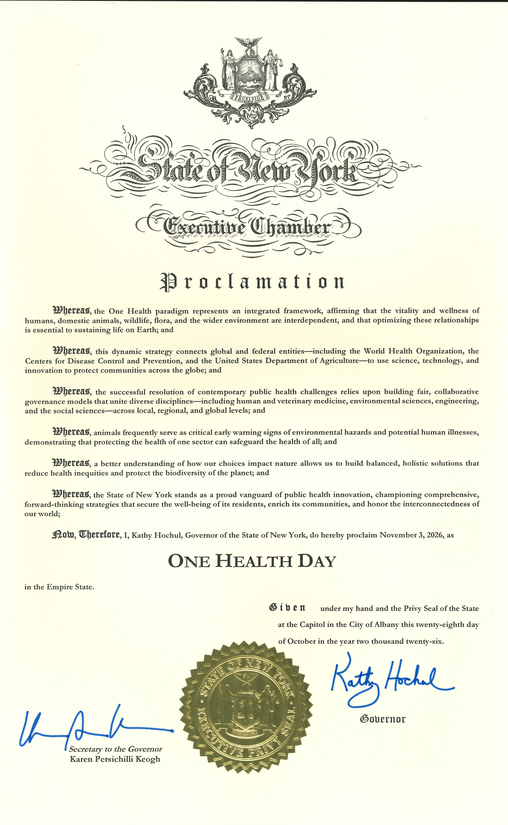
NYSVMS received One Health Day State Proclamation
At the July meeting of the AVMA House of Delegates, the House adopted a resolution https://www.avma.org/sites/default/files/2026-07/2026A_Resolution6F.pdf encouraging state proclamations recognizing November 3, 2026, as One Health Day. This initiative was led by the National Association of Federal Veterinarians and a small coalition of associated organizations for the purpose of expanding political will for One Health. Several other states have similar One Health Day gubernatorial proclamations. Thank you to our legislative counsel, Emily Whalen, Esq. for assisting with this process and to Governor Kathy Hochul for recognizing the importance of veterinarians in public health.
Page 6
NYS Veterinary Conference
2026 NYS-VC was a great success!
NYSVMS and Cornell University College of Veterinary Medicine hosted the New York State Veterinary Conference October 9–11, and this year’s event was even bigger than last year’s, with more than 1,100 attendees in person and online. The conference offered something for everyone, with 20 tracks covering a range of species and professional development topics, more than 30 speakers, and up to 20 hours of continuing education (CE) credit. Attendees could also take part in self-study CE, labs, tours, chair massages, and evening events. There were two evening receptions: one held offsite once again at the Marriott in downtown Ithaca, and the other before the Dee Arrison Concert for Animals. Attendees could also visit exhibitors to collect stamps on their game cards for a chance to win raffle prizes.
If you weren’t able to attend, there’s still time to earn up to 22.5 hours of self-study CE toward your license renewal by registering for on-demand access! The on-demand platform features more than 90 session recordings from the live event, each paired with an assessment for self-study CE credit. For $349, you’ll have access to all species and professional development tracks through January 6, 2027. For more information and to register, visit www.nysvc.org.


Photos by: Stephanie Donovan and Katelynn Wagner
Thank you to our NYS-VC Sponsors

Thank you to our 2026 Exhibitors:
AnalytiChem
Antech/Sound/Heska
ASPCA
Banfield Pet Hospital
Blue Buffalo Company
Blue River PetCare
Boehringer-Ingelheim Animal Health USA, Inc.
CareCredit
Ceva Animal Health
Chewy Health
Choice Medical Systems / Samsung
Christian Veterinary Mission
Comparion Insurance Agency
Cornell University Hospital for Animals
Cornell Animal Health Diagnostic Center
CVM Animal Health Centers
Dairy One
Elanco
Epicur Pharma / Stokes Pharmacy
Guardian Veterinary Specialists
Hill’s Pet Nutrition
IDEXX
Instinct
Marshall Farms
Merck Animal Health
Midwest Veterinary Supply
Mixlab
Monarch Practice Transitions
Nutramax Laboratories Veterinary Sciences, Inc.
Optimum Pet Vitality
Physician’s Resource PRI/Mindray Animal
Purina
RedWyre Technology Solutions
Rose Micro Solutions
Scratch
Stone Built Insurance
TeraNova Veterinary
TMGvets
Total Practice Solutions Group
Universal Imaging
VCA Animal Hospitals
VetScalpel Surgical Lasers
Visbiome Vet
Zoetis
Page 7
Classifieds
Kings County, NY
Solo DVM, Small Animal Practice for Sale. Generating over $1.14M in gross revenue with an estimated $347K cash flow in 2025, this well-established practice features a 1,900+ SF leased facility with 2 exam rooms (room for a third), excellent visibility, and strong growth potential. Seller transition available. (Listing #NY25). Contact: PS Broker, Email: info@psbroker.com, Phone: (800) 636-4740, Website: https://go.psbroker.com/NY25.
Suffolk County, NY
1.5 DVM, Small Animal Practice for Sale. Generating over $3.6M in gross revenue with estimated cash flow approaching $950K, this well-established practice features a 4,000 SF facility with 3 exam rooms, excellent visibility, and significant growth potential. Over 750 new clients in 2025! Seller transition available. (Listing #NY26). Contact: PS Broker, Email: info@psbroker.com, Phone: (800) 636-4740, Website: https://go.psbroker.com/NY26.
Page 8
News To Use
Important phone numbers and contacts
Tap any number to call.
NYS Education Department
Main line for extensions above: (518) 474-3817
NYS Department of Health
Agriculture & Markets
DEA & NYSVMS
Affinity partners, CareCredit, CorpCare and TMGvets, are listed at nysvms.org/member-benefits-2.
Page 9
Advertisement


ARK Veterinary Hospital & Urgent Care
Emergency, urgent care and exotic pet medicine in Henrietta, NY. Open 7 days a week, including holidays. 35 Finn Road, Henrietta, NY 14467.
Hiring: apply at arkvh.com/careers.