
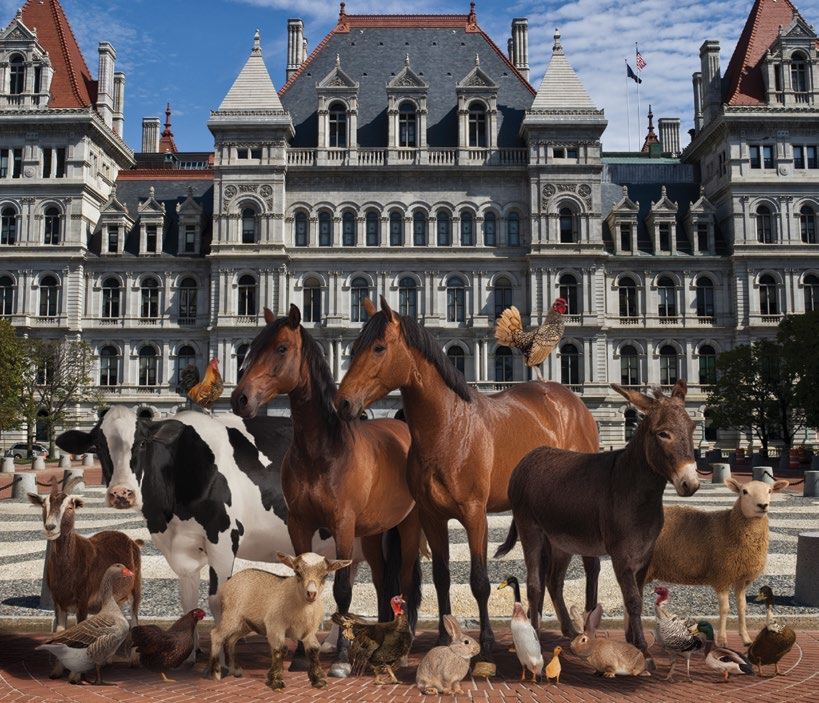
The New York State Veterinary Medical Society represents thousands of veterinarians across the state and is the acknowledged and respected voice for the profession of veterinary medicine in New York. Our mission is to protect, promote, and advance the science and profession of veterinary medicine and to ensure that New Yorkers have access to the highest caliber of veterinary care available.
The NYSVMS Government Relations Committee, in collaboration with legislative counsel and the Grassroots Legislative Network (GRLN), advocates on behalf of the profession by monitoring legislation that has a direct impact on how members practice. The typical session begins in January, with most of the focus on the state budget until the new fiscal year starts April 1st; the legislature then shifts to non-fiscal issues until the session concludes in June. In 2026, the budget process lasted until the end of May, leaving only a short window for non-fiscal issues.
Below is where the bills on the NYSVMS 2026 Legislative Agenda — and other items of importance — ultimately landed.
Protecting a veterinarian's license to practice
NYSVMS worked throughout the session to combat legislation that would restrict or prohibit specific procedures or medicinal protocols.
Bark softening. Senator Gianaris (S.3026) and Assemblyman Dais (A.8551) sponsor legislation that would prohibit bark softening in dogs unless performed by a veterinarian where the procedure is medically necessary. NYSVMS strongly believes bark softening is a medical decision that should be left to the sound discretion of fully trained, licensed, and state-supervised veterinary professionals, and that the determination should be made case by case rather than through an outright ban. The Senate passed the bill, as it has each of the previous three years; it moved through committee in the Assembly but did not ultimately pass that house. NYSVMS will continue to oppose any outright ban.
Antimicrobials in food animals. Legislation restricting the use of medically important antimicrobials in food-producing animals (Senator Kavanagh S.3220 / Assemblymember Rosenthal A.1667) did not move in either house. If enacted, the bill could restrict food-animal practice in ways detrimental to animal welfare and impose an onerous set of reporting requirements. Its annual reintroduction allows NYSVMS to keep educating legislators about the guidelines veterinarians already follow.
Xylazine. Three standalone bills were reintroduced. S.5421 (Skoufis) would designate xylazine a Schedule III depressant and has not moved since 2023. S.4676 (Murray) / A.5099 (Stern) would add xylazine to the controlled-substances list with an exemption for veterinary medical use, and did not move in 2026. S.7668-A (Fernandez) / A.1248-C (Tapia) would prohibit the sale of more than 50g of xylazine per sale for non-institutional, non-veterinary, non-scientific use; it passed the Assembly for the fourth year in a row but did not pass the Senate. NYSVMS remains a resource to help lawmakers distinguish illicit xylazine from its legitimate veterinary use.
Protecting veterinarians from liability
Animal guardianship. Assemblymember Glick has long sponsored legislation (A.1334) that would establish a civil cause of action for the wrongful death of a companion animal, brought by a court-appointed guardian; Assemblymember Rosenthal carries a similar bill (A.3115). Neither has a Senate companion. NYSVMS has opposed this type of legislation for many years on the basis that it could lead to costly court-ordered damages and change how SPCAs and animal-control officers deal with injured, dangerous, or unadoptable animals, and could invite lawsuits based on accepted veterinary practices. NYSVMS will continue to oppose guardianship legislation.
Other and new bills
Sentient beings. A new bill (S.9569 Martinez / A.11094 Gonzalez-Rojas) would classify companion animals as sentient beings for the purpose of animal-cruelty crimes. It did not move this year; NYSVMS is reviewing the bill text and has not yet formed a position.
Shelter standards. NYSVMS supported allied welfare organizations' efforts to update shelter-standards law. A “clean-up” proposal, active during the 2026 session, originally included language allowing individuals under the direct supervision of a veterinarian to perform tasks such as vaccination before an animal enters a shelter's general population. That provision was removed during negotiations and the bill did not pass both houses. NYSVMS will keep working toward passage of the updated standards — including workforce flexibility — or standalone legislation that achieves the same goals.
Get involved with advocacy at nysvms.org, or contact the Government Relations Committee to join the Grassroots Legislative Network.